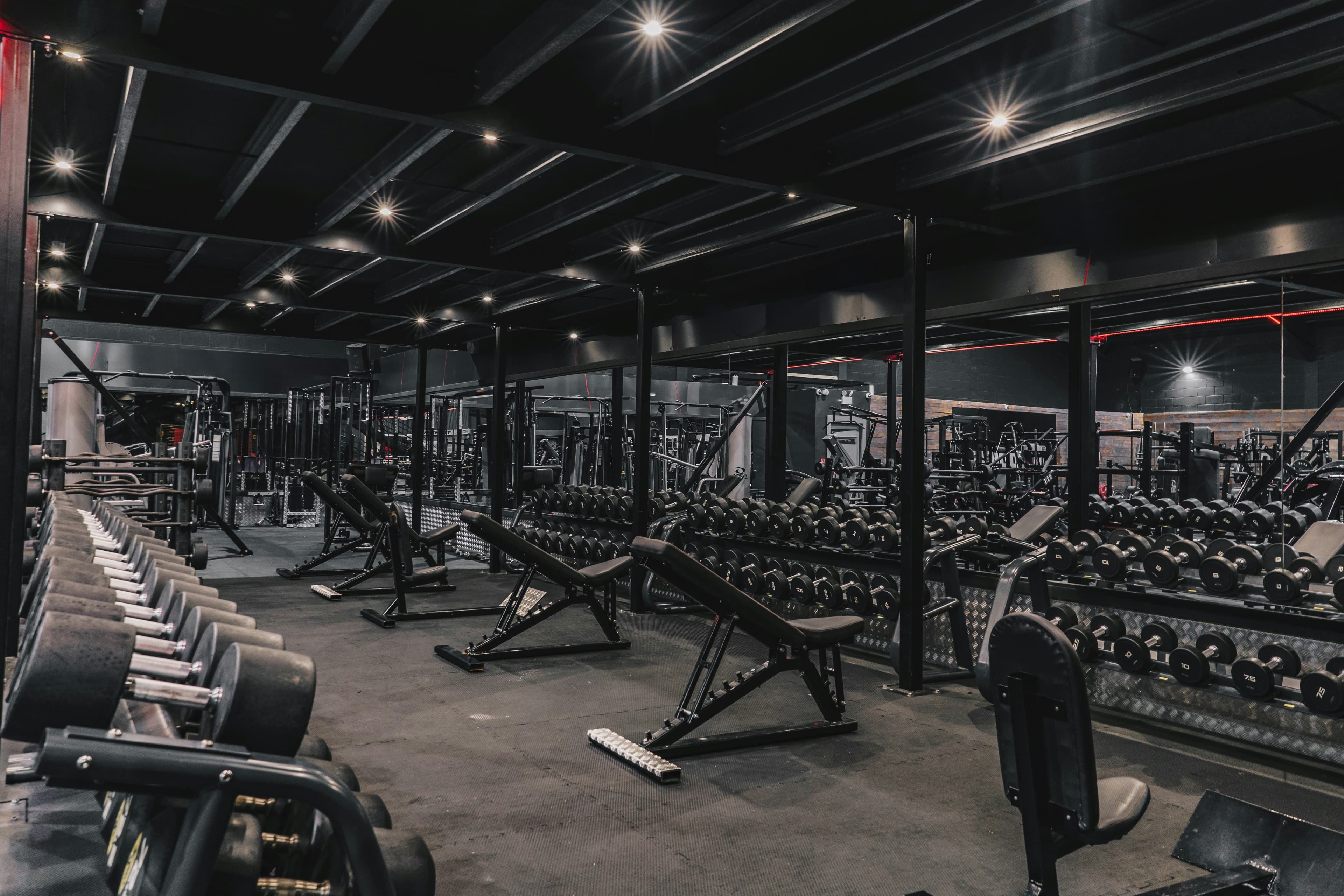
Walk onto any gym floor and you'll see the same split: a wall of dumbbell racks and adjustable benches on one side, a row of machines on the other. New lifters end up staring at both, unsure which one is actually the better use of their time.
For building muscle, free weights and machines produce similar growth when sets, reps, and effort are matched — the difference isn't hypertrophy, it's everything around it. Free weights add stabilizer and coordination demand that carries into real-world strength; machines let you isolate a muscle and push closer to failure with less injury risk. The strongest programs use both, not one instead of the other.
Do Free Weights Build More Muscle Than Machines?
Not meaningfully, on their own. Muscle growth is driven primarily by training volume — sets taken close to failure, repeated over time — not by which tool provides the resistance. A dumbbell press and a machine chest press, loaded and programmed to the same volume and intensity, put comparable growth stimulus on the chest.
What differs is what happens around the target muscle. A barbell squat also demands your core, hips, and stabilizers hold the bar path steady — that's real, functional strength you don't get sitting in a fixed machine track. A leg press removes that demand entirely, which is exactly why it lets you isolate the quads and push harder without balance being the limiting factor.
When Free Weights Have the Edge
- Compound, multi-joint movements. Squats, deadlifts, presses, and rows train several muscle groups at once and mirror how your body actually moves outside the gym.
- Stabilizer and core engagement. Holding a dumbbell or barbell steady recruits smaller stabilizing muscles a machine's fixed path bypasses.
- Unilateral training. Single-arm and single-leg free-weight work exposes and corrects side-to-side imbalances that bilateral machines can mask.
- Carryover to sport and daily life. Balance, coordination, and real-world strength transfer better from movements that aren't locked to a rail.
When Machines Have the Edge
- Lower learning curve. A leg press or lat pulldown has almost no technique barrier — you can load it safely on day one.
- Joint-friendly isolation. A fixed path lets you target one muscle without asking a sore shoulder or cranky lower back to stabilize the load too.
- Training closer to failure, safely. No spotter needed — machines let you push the last rep or two of a set without the fall-risk of a missed barbell lift.
- Efficient volume. Quick pin-adjustments mean more working sets per session with less setup between them.
Free Weights vs. Machines: Quick Comparison
| Factor | Free Weights | Machines |
|---|---|---|
| Muscle growth | High (with matched effort) | High (with matched effort) |
| Stabilizer/core demand | High | Low |
| Beginner learning curve | Steeper | Minimal |
| Safe to train to failure | Needs a spotter or safety pins | Yes, generally |
| Real-world strength carryover | High | Lower |
| Best for | Compound lifts, athletes | Isolation, injury recovery, beginners |
How to Combine Both for the Best Results
Most well-built programs don't pick a side — they sequence both. Start sessions with a compound free-weight lift while you're fresh and coordination matters most (squat, bench, deadlift, row), then finish with machine work to isolate the muscle and safely chase the last few reps of fatigue (leg extension, chest press machine, lat pulldown).
That's also how Krato structures adaptive programs: compound free-weight movements anchor the session, machine and isolation work fills in around them, and the plan adjusts set to set based on what you actually lifted — not a fixed spreadsheet that ignores how the session is going.
Krato pairs every set with an expert cue and adapts your plan as you train — free on the App Store.
Try Krato Free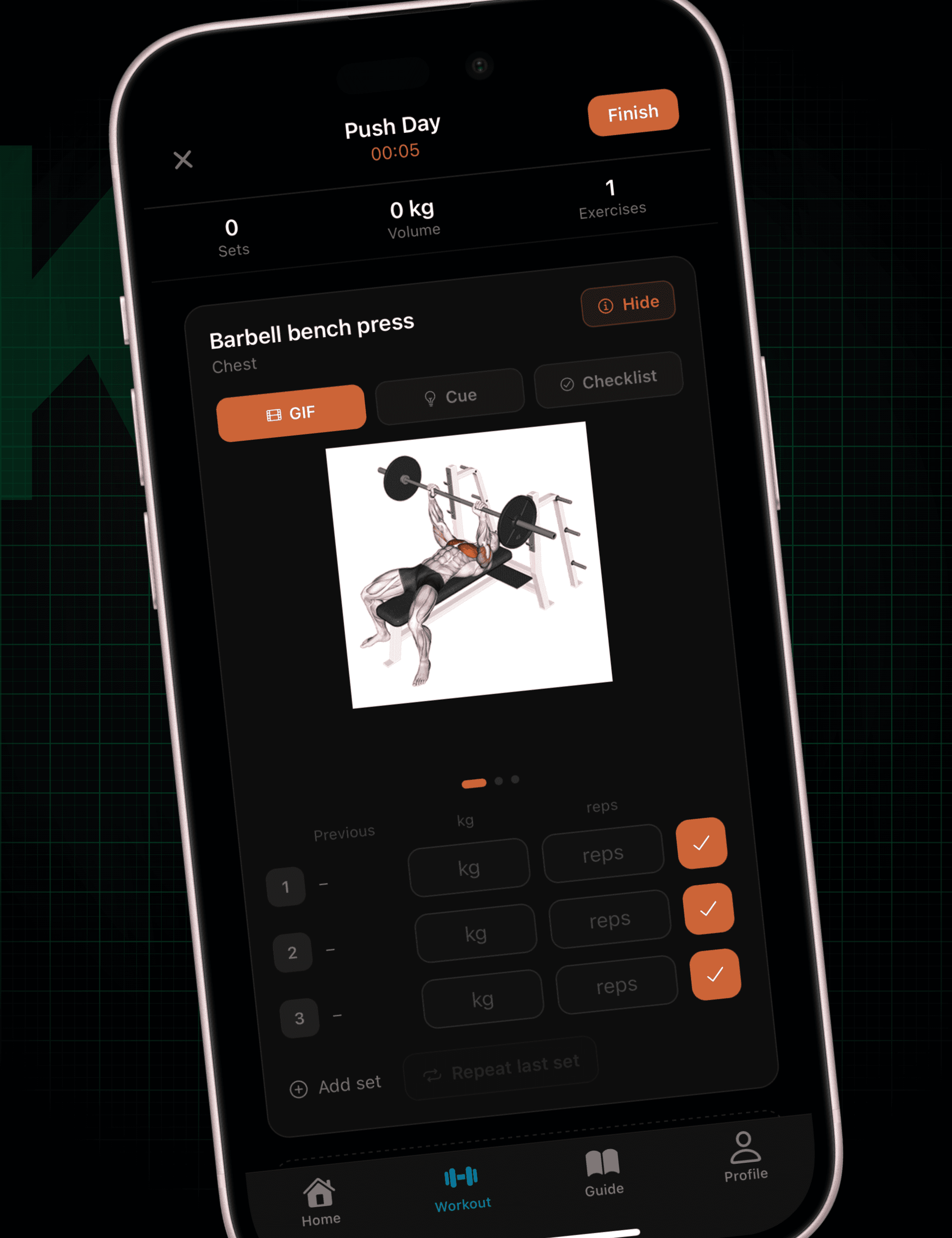
Frequently Asked Questions
Are machines bad for building muscle?
No. Machines build muscle just as effectively as free weights when training volume and intensity are matched. They're often the safer choice for pushing a set closer to failure.
Should beginners start with machines or free weights?
A mix works best: machines to build confidence and muscle without a steep technique curve, alongside light free-weight compound lifts to start developing coordination and stabilizer strength early.
Can you build a full physique with just machines?
Yes, machines alone can build significant muscle. What you'll miss is the coordination, balance, and stabilizer strength that free-weight compound lifts develop — worth adding in even in small doses.
Krato builds your plan around compound lifts and adapts every session based on your actual performance — free on the App Store.